“Make it cool” is how most promo briefs start, and it’s the least useful instruction in marketing. A better question is what the viewer should see, and what single creative decision makes them keep watching. Every example below answers that question differently.
The ten promo videos in this gallery span a 15-second product spot, a four-minute customer story, an animated software explainer and a Big Game commercial. Each one is on its brand’s official channel, and we checked that it plays and noted its length on November 4, 2026. Years are the official upload dates, which can differ from a campaign’s first airing.
For each example you’ll get what happens, why it works, and the move you can borrow without the budget.
Key Takeaways
- Choose the format from your goal first: launch, explain, build trust, get noticed, or promote an event.
- The best promo videos make one creative decision you can name in a sentence, then commit to it.
- Show the product’s result, a real customer, or a visible argument. Mood alone rarely carries a promo.
- Most of these moves cost little: a split-screen edit, a single joke with a product payoff, a founder talking to camera.
- Cut a master version first, then make the 15-second, vertical and captioned versions from it.
The 10 Examples at a Glance
| # | Brand and film | Year | Length | Format | The move to borrow |
|---|---|---|---|---|---|
| 1 | Liquid Death, “Safe For Work” | 2025 | 30 s | Comedy spot | Borrow a genre’s look, then flip it |
| 2 | Channel 4, “Considering What?“ | 2024 | 140 s | Event film | Turn the audience’s assumption into the villain |
| 3 | Amazon, “Alexa – Mission Possible” | 2022 | 15 s | Short product spot | One action, one payoff |
| 4 | GoPro, “Introducing HERO10 Black” | 2021 | 89 s | Launch montage | Let the product’s output be the ad |
| 5 | Switzerland Tourism, “No Drama.” | 2021 | 91 s | Celebrity contrast | Sell the destination by arguing against it |
| 6 | Nike, “You Can’t Stop Us” | 2020 | 60 s | Split-screen anthem | Make the edit carry the message |
| 7 | Slack, “You’ve Probably Heard of Slack” | 2019 | 119 s | Story demo | One person, one problem, one product |
| 8 | Calm, “Calm Stories: Ajani” | 2019 | 238 s | Customer story | Give a real customer room to talk |
| 9 | Klear, “Klear” | 2016 | 92 s | Animated explainer | Draw the abstract service |
| 10 | Dollar Shave Club, “Our Blades Are F***ing Great” | 2012 | 93 s | Founder-led explainer | One offer, delivered by the founder |
What Makes a Promo Video Example Worth Studying
We picked these ten with three checks in mind. They’re editorial judgments, not performance data: views and awards don’t prove a video sold anything.
- The premise fits in one sentence. “People drink from tallboy cans in places they shouldn’t, and it’s water” is a premise. “We celebrate our brand values” is not.
- One craft choice is doing the work. You can point to it: the split screen, the reveal, the founder’s delivery.
- The point is on screen. The product’s result, a real customer, or the argument itself is visible, not only implied by music and mood.
We also kept the list to videos you can still watch on the brand’s own channel, and balanced big-budget spots with formats a small team can actually make.
1. Liquid Death, “Safe For Work” (2025, 30 s)
Watch on YouTube. Liquid Death’s 2025 Big Game commercial borrows the grammar of an irresponsible beer ad: surgeons, judges and police drinking on the job from tallboy cans, with pour shots and conspiratorial grins. The reveal is the product: they’re drinking water. The brand’s own description sums up the joke as looking like a degenerate while making great life choices (Ad Age’s Super Bowl archive has the spot and credits).
Why it works: the audience’s familiarity with beer ads does half the work. Viewers commit to the wrong reading, and the product corrects it.
Steal this: pick the genre your category is usually confused with, or the one it’s quietly competing with. Copy that genre’s visual shorthand for the first two-thirds of the spot, and let the product reveal resolve it. Shorthand is cheaper than spectacle.
2. Channel 4, “Considering What?” (2024, 140 s)
Watch on YouTube. Channel 4’s film for its Paris 2024 Paralympics coverage shows athletes competing against the forces every athlete faces, gravity, time and friction, rendered as physical opponents. Channel 4’s description makes the argument plainly: those forces don’t change for anyone.
Why it works: it names the patronizing thought some viewers bring to Paralympic sport (“amazing, considering…”) and turns it into the antagonist. You can’t finish the film still holding that thought.
Steal this: write down the one unspoken assumption your audience has about your category. Make it a visible character, object or obstacle in the video rather than a line of dialogue.
3. Amazon, “Alexa – Mission Possible” (2022, 15 s)
Watch on YouTube. A 15-second spot built around one voice command and its result, with the caption “Secure your space with the power of your voice.”
Why it works: fifteen seconds is enough for exactly one setup and one payoff, and this spot doesn’t try to fit in a second feature.
Steal this: for a short slot, cut your feature list down to the single action a viewer can understand without sound. Let a sound effect or the product’s response mark the payoff, and end there.
4. GoPro, “Introducing HERO10 Black” (2021, 89 s)
Watch on YouTube. GoPro launched the HERO10 Black, with its new GP2 chip, 5.3K video and HyperSmooth 4.0 stabilization, with a montage of footage that shows those specs in action rather than reading them out.
Why it works: for a product that makes something, the output is the best proof. Every shot is evidence for the spec sheet.
Steal this: if your product produces anything visible (footage, designs, meals, finished rooms), build the launch video from real outputs. Put one line of text on screen for each claim, over the shot that proves it.
5. Switzerland Tourism, “No Drama.” (2021, 91 s)
Watch on YouTube. Roger Federer invites Robert De Niro to be part of a film about Switzerland. De Niro turns him down: the country is beautiful, he says, but there’s no drama. Every rejection becomes a selling point.
Why it works: the objection is the pitch. The more De Niro complains, the better Switzerland sounds to anyone looking for a calm holiday.
Steal this: list the reasons someone might find your product boring: too simple, too safe, too reliable. Put that complaint in a character’s mouth and let the audience disagree.
6. Nike, “You Can’t Stop Us” (2020, 60 s)
Watch on YouTube. Two halves of the screen play different athletes, in different sports and places, whose movements continue across the split as if they were one motion. (The link is Nike Japan’s official upload.)
Why it works: the edit is the message. Without a word of explanation, the matched movement says these people share something.
Steal this: you don’t need Nike’s archive. Pair customer clips, before-and-after shots, or “then and now” footage on a split screen and match their motion at the seam. A few well-matched pairs carry a 15-second cut.
7. Slack, “You’ve Probably Heard of Slack” (2019, 119 s)
Watch on YouTube. The film follows Brianna, who uses Slack for everything at work, through channels by team or project and the tools her colleagues already use.
Why it works: software is abstract until you watch a specific person get a specific job done. One character makes the features legible.
Steal this: give your software demo a protagonist with a recognizable job. Show three moments in their day where the product removes friction, and skip any feature that doesn’t fit that day.
8. Calm, “Calm Stories: Ajani” (2019, 238 s)
Watch on YouTube. Ajani, a photographer and entrepreneur, describes his mind as having “numerous tabs open” and explains how he meditates, sometimes for ten seconds at a time, even on the subway.
Why it works: the detail is specific and human, so the product’s benefit feels earned rather than claimed. Nearly four minutes is long for a promo, and it works because the story has room to breathe.
Steal this: interview one customer about a specific habit, not about your product. Cut it to the moments where the product shows up in their life. A phone, a lav mic and good light are enough.
9. Klear, “Klear” (2016, 92 s)
Watch on YouTube. An animated explainer for Klear, a social intelligence platform for influencer marketing and social analytics, that shows how the service works step by step.
Why it works: some services have nothing to film. Animation turns an invisible process into objects and arrows a viewer can follow.
Steal this: if your product is a process (a platform, a workflow, a back office), storyboard it as five drawings: problem, input, what happens, result, next step. Animate between them with simple transitions; motion graphics can be generated and edited without After Effects.
10. Dollar Shave Club, “Our Blades Are F***ing Great” (2012, 93 s)
Watch on YouTube. Founder Michael Dubin walks through his warehouse delivering the pitch in one deadpan monologue: good razors for a few dollars, delivered. He wrote the script; Lucia Aniello directed.
Why it works: a single clear offer, delivered by the person who believes it most, with jokes that never get in the way of the proposition.
Steal this: if you’re a founder, you’re the cheapest spokesperson you’ll ever hire. Write a 90-second walk-and-talk with one offer, film it in your actual workspace, and cut out every line that doesn’t support the offer.
Choose a Format by Goal
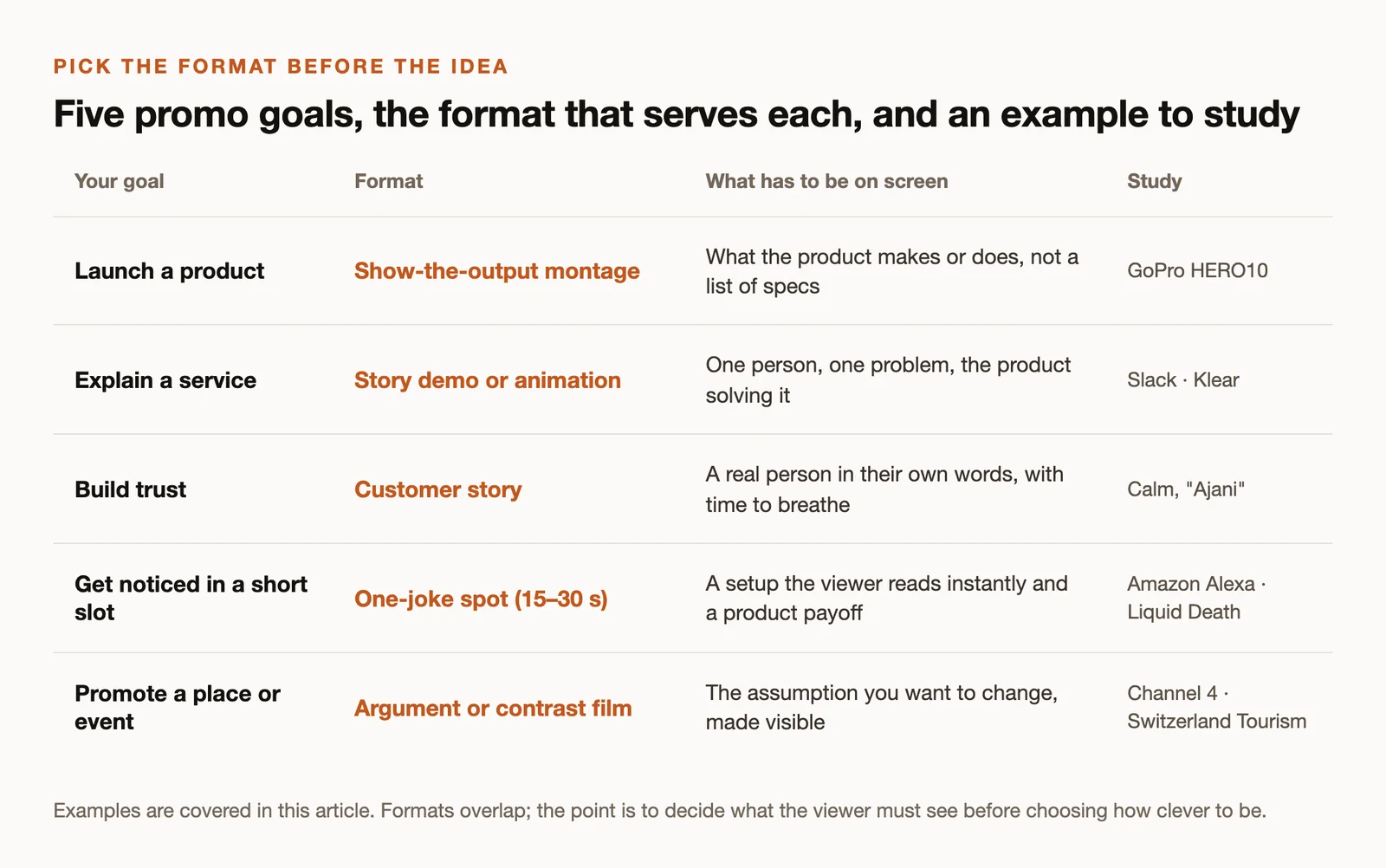
The formats overlap, but the order of decisions matters. Start with what the video has to accomplish, then choose the format, then look for the creative move. Teams that start with “something like the Liquid Death ad” usually end up with a joke that doesn’t fit their product.
How to Make Your Own Promo This Week
- Write the premise in one sentence. If it takes two, it’s still a brief.
- Pick the format and the length from the table above. Write for the shortest version first; a good 15-second idea expands, but a 90-second idea rarely survives cutting.
- Collect the proof. Product footage, a customer, screen recordings, the founder. Whatever goes in the “has to be on screen” column.
- Edit one master cut. Get the story right at its natural length before you think about placements.
- Make the versions from the master. A 15-second cut, a vertical 9:16 version with captions for Reels and Shorts, and a 6-second bumper if you’re buying YouTube ads.
The last step is where most of a small team’s time goes, and it’s mechanical. In ChatCut you can ask for the versions in one request and get each on its own editable timeline:
ChatCut runs on macOS, Windows and the web, and connects to Claude Code and Codex as a plugin. Exports go up to 1080p in the cloud and 4K when rendered locally on Desktop. For a product-focused promo built from scratch, see the best promo video makers and the product explainer video guide.
Six Questions Before You Brief a Promo
- What’s the one-sentence premise? If your brief needs two sentences, cut it to one.
- What must be on screen? The output, the customer, the argument, or the founder.
- Which single creative move carries it? A reveal, a split screen, a contrast, a character, a monologue.
- Could a team with your budget make it? If not, find the version of the move that can.
- What’s the shortest version? Write that first.
- What happens after someone watches? A link, an offer, a next video. Decide before you shoot, not after.